


Thanksgiving in Provence: when American traditions become part of a French immersion
Updated: Sep 22

I discovered Thanksgiving thanks to my American students.
When I started welcoming people from the United States to learn French in Provence, this celebration naturally became part of the stories they shared, their traditions and sometimes their stays with us. I discovered a tradition that is very important to them, built around a simple idea: getting together, sharing a meal and taking the time to give thanks.
And over the years, through these immersions, I realized something else: when you spend a few days living with your teacher, you don’t necessarily leave your own culture at the door. You bring it with you.
And that’s actually one of the things I love about these stays.
You come to Provence to learn French and discover our way of life. But you also bring a little bit of home with you. Sometimes through a story. Sometimes through a tradition. And very often… through food.
Thanksgiving is a perfect example.
Thanksgiving, a tradition my students introduced me to
In the United States, Thanksgiving is celebrated on the fourth Thursday of November. In Canada, it takes place earlier, on the second Monday of October. In both countries, it is a time when families traditionally gather around a meal.
The American tradition is associated with a meal shared in 1621 between English settlers, often referred to as the Pilgrims, and the Wampanoag people after a harvest. Today, for many families, Thanksgiving remains above all an important family gathering.
The meal often includes roast turkey, mashed potatoes, cranberry sauce and pumpkin pie, as well as cornbread or sweet potato casserole.
These dishes are obviously quite different from the ones we usually prepare here in Provence.
And that is precisely what makes these exchanges so interesting.
When a student tells me about a dish from their childhood or a recipe their family prepares every year, we are no longer simply talking about food. We are talking about memories, traditions, family and culture.
And we are doing it in French.
Celebrating Thanksgiving during a French immersion in Provence

When Thanksgiving falls during a student’s stay, I would never expect them to forget about the celebration simply because they are in France. Quite the opposite.
If they would like to prepare a traditional Thanksgiving meal, I suggest that we make it at home. Some prefer to experience the day “the French way.” Others want to keep their own traditions. Both are perfectly fine with me.
That is also what living with your host during an immersion is about: sharing our daily life without having to leave your own traditions behind.
So we might end up with a table where Thanksgiving turkey meets a Provençal vegetable tian. Traditions mingle, everyone talks about what they know and, in the end, the conversation becomes almost as important as the food on our plates.
For me, these simple moments are what make an immersion so meaningful.
Cooking, a language we all share
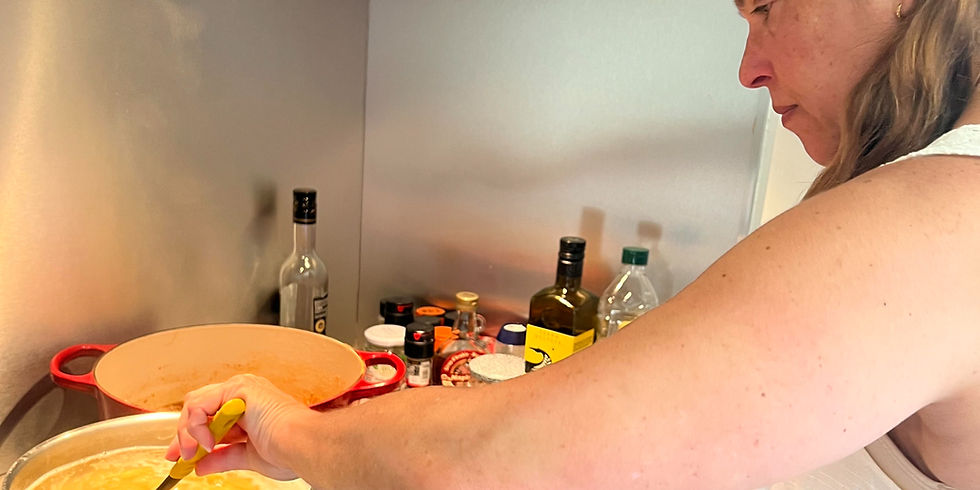
Thanksgiving has also made me think about the role food plays during my immersions.Because the truth is, my students don’t wait until November to share their recipes with us!
Theresa, whose family is originally from Italy, once prepared her spaghetti Bolognese for us.
Jeanne, who came from Iowa, made a chicken pot pie.
And Louise and Julian, a British couple, prepared homemade garlic bread and meatballs for the whole family.
I love these moments.
For a few hours, our roles change a little. Usually, I’m the one introducing my students to French and Provençal food. This time, they are the ones inviting us into their world. We discover a recipe.
Sometimes we look for the right word for an ingredient in French or English.
We talk about the way people cook in their country and in ours.
And of course, we taste everything!
Cooking becomes a wonderful opportunity for conversation. French is no longer simply the language of the morning lesson. It becomes the language we use to prepare, explain, ask questions, tell stories and share.
And that is exactly what I look for in an immersion.
Learning French around the table

Sometimes, all it takes is a craving…
I also think of Barbara, who really wanted to eat pumpkin pie during her stay. The problem was that it isn’t something you can easily find in France! So rather than giving up on the idea, we decided to make one ourselves.
It was a first for me too: I had never made pumpkin pie before! So we found a recipe, gathered the ingredients and made our first pumpkin pie together. It was such a simple moment, but a really lovely one. And I particularly like this memory because, this time, my student was also introducing me to something from her culture.
That is exactly what I love about an immersion: you come to Provence to discover our language and our way of life, but the exchange goes both ways. A simple craving can become an opportunity to cook together, speak French and share a little piece of our respective cultures.
I love these moments. For a few hours, our roles change a little…
We often imagine that progressing in a language means studying more. Of course, lessons are important. But a language is also built through all the little moments of everyday life.
While preparing a meal, you can learn very practical words: to cut, to mix, to taste, to add, to cook, to serve… You can explain a recipe, share a memory or compare two different ways of preparing the same dish.
Most importantly, you are using French because you actually need it at that moment.
There is no exercise to get right. There is simply something you want to say.
That is one of the reasons I love bringing everyday life into my immersions. Food naturally creates conversation. It leads us to talk about our families, our regions, our habits and sometimes even our childhood memories.
Of course, you learn vocabulary. But you also get to know one another.
Bringing a little of your own culture to Provence
An immersion is often presented as a way of discovering another culture.
For me, the exchange goes both ways.
When you come and stay with us, you discover our daily life, our meals, our region and our way of living. You hear French in the morning, around the table, during an excursion or simply in the middle of an everyday conversation.
But we also discover something about you.
A recipe from Iowa.
An American tradition.
A British dish.
A family story.
That is the mix I love.
Over the years, my students have taught me so much about their countries, their traditions and their cultures. Thanksgiving is one of those traditions I probably would never have discovered in quite the same way without them.
Of course, I could read an article about Thanksgiving.
But listening to someone explain why this celebration matters to their family, and then sharing a meal with them, is something completely different.
It is a real encounter.
And ultimately, that is exactly what learning a language is for.
French vocabulary for Thanksgiving and cooking
French | English |
Thanksgiving | Thanksgiving |
une tradition | a tradition |
la gratitude | gratitude |
un repas | a meal |
une récolte | a harvest |
une dinde | a turkey |
une purée de pommes de terre | mashed potatoes |
une sauce aux canneberges | cranberry sauce |
une tarte à la citrouille | pumpkin pie |
une recette | a recipe |
un ingrédient | an ingredient |
couper | to cut |
mélanger | to mix |
goûter | to taste |
cuire | to cook |
servir | to serve |
partager | to share |
Frequently asked questions about Thanksgiving during a French immersion in Provence
Can you celebrate Thanksgiving during a French immersion in France?
Yes. When my students are staying with us at that time of year and want to keep their Thanksgiving traditions, they can simply talk to me about it and we can include the celebration in their stay.
Is Thanksgiving celebrated in France?
Thanksgiving is not a French holiday. For my American students, that is precisely what makes it such a lovely opportunity to talk about their culture and explain their own traditions to me.
Can you cook during an immersion with Virginie?
Yes. Theresa, Jeanne, Louise and Julian are all good examples: each of them was able to prepare and share a recipe with us.
Does cooking help you learn French?
Above all, it gives you an opportunity to use French in a very practical situation: understanding a recipe, naming ingredients, explaining what you are doing, asking questions and chatting around the table.
Do you need a good level of French to take part in these moments?
The goal is not to speak perfect French. An everyday activity such as cooking gives you the opportunity to use simple words, ask questions and communicate in a real-life situation.
Thanksgiving in Provence: ultimately, a story of sharing
When I discovered Thanksgiving through my American students, I initially discovered a tradition that was not my own. Over time, I began to understand why it fits so naturally into an immersion.
Because it is about food, family, gratitude and sharing. And these are precisely the moments I love most about my work.
Of course, my students come to stay with me to learn French. But for a few days, we also share a home, meals, excursions, conversations and little pieces of our respective lives.
So if you come to Provence around Thanksgiving and this tradition is important to you, tell me.
You won’t have to choose between your culture and ours.
We will simply find a way to bring the two together around the same table.
Discover French immersion with Virginie in Provence
Come and experience French as part of everyday life in Provence, through lessons, conversations, meals, encounters and all those little situations that bring a language to life.
You may also like
Discover another side of Provençal gastronomy through traditions, local know-how and moments shared together.
Markets, landscapes, flavors and traditions: discover what makes Provence so special at this time of year.
Discover how French can also be learned through meals, outings and the simple moments of everyday family life.


Comments