


Can you really improve your French in just one week?

The answer is yes! You really can make progress in French during a one-week immersion program. And it's something I regularly see with the students who come to learn French with me in Provence.
Of course, it all depends on your starting level, your needs, and, most importantly, your goals. That's actually where we begin: understanding what you'd like to improve so I can create a program that truly suits you.
Most people who choose a French immersion program primarily want to speak French more easily, build confidence, and feel more comfortable expressing themselves. That's why progress is often most noticeable in speaking. But if your goal is to improve your written French, we can absolutely dedicate part of our lessons to writing, grammar, or reading comprehension.
What matters most is focusing on what you really need.
And sometimes, the changes happen much faster than you might expect.
Is one week really enough to see progress?

Imagine your first day of immersion.
I ask you what you did the day before. You understand the question, but you struggle to find the right words.
You think about verb conjugations, hesitate over a preposition, and eventually manage to put a few sentences together.
A few days later, I ask you a similar question.
This time, you get started more easily. You might still hesitate over a verb, but you can explain where you went, what you discovered, and why you enjoyed it.
You haven't become bilingual in five days, of course!
But you've started developing new reflexes.
You spend less time searching for certain words, understand questions more quickly, and take more initiative in conversations.
Making progress doesn't necessarily mean learning hundreds of new words. It also means becoming better at using the words you already know.
And that's exactly what immersion allows you to do: practice French often enough that using it starts to feel more natural.
How your French listening comprehension can improve
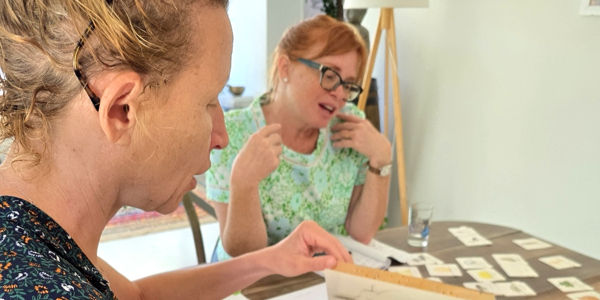
You may have experienced this before: you understand a sentence perfectly when you read it, but when a French person says it out loud, you struggle to recognize the words.
That's completely normal. Understanding spoken French requires different skills from reading.
During a week of immersion, you hear French in many different situations: at breakfast, during lessons, at the market, in restaurants, or on excursions.
And most importantly, you encounter the same expressions again and again.
For example, someone might ask you:
"Vous avez passé une bonne journée ?" (Did you have a good day?)
"Alors, cette journée ?" (So, how was your day?)
"Qu'est-ce que vous avez fait aujourd'hui ?" (What did you do today?)
These three questions are different, but they all invite you to talk about the same thing.
Gradually, you learn to recognize expressions, intonation, and what the other person is trying to communicate.
You also begin to understand French as it's actually spoken, with its contractions, informal expressions, and different ways of saying the same thing.
Sometimes, your first sign of progress is simply understanding a question without having to ask someone to repeat it.
And that's already a big achievement!
How your spoken French can improve

You find the words you already know more easily
When learning a foreign language, we often know far more words than we can spontaneously use.
You know what ça dépend (it depends) means, but the expression doesn't necessarily come to mind when you need it.
During an immersion program, you might use it several times in the same week:
"Ça dépend de la météo." (It depends on the weather.)
"Ça dépend de ce que nous allons visiter." (It depends on what we're going to visit.)
"Ça dépend de mes envies." (It depends on what I feel like doing.)
By using the same expressions repeatedly in different situations, they gradually become more natural.
That's one of the greatest advantages of immersion: you're not simply learning vocabulary, you're learning how to use it.
You learn to keep a conversation going, even when you get stuck
For me, this is one of the most interesting kinds of progress.
Imagine you want to describe a traffic jam, but you don't know the French word bouchon.
You could stop, search for the word, and eventually give up on your story.
Or you could explain:
"Il y avait beaucoup de voitures et nous avancions très lentement."
(There were lots of cars, and we were moving very slowly.)
The person you're speaking to immediately understands what you mean.
They might give you the word you were looking for, and you can continue your story.
You've just done something essential: you've managed to communicate without knowing every single word.
This is a skill I particularly enjoy working on during my private French lessons.
I'd always rather see a student try to explain an idea using the words they know than give up speaking because they're missing one word.
You become more confident
This is often one of the most important changes.
Some people arrive for their immersion program with a good understanding of grammar and plenty of vocabulary, but they're afraid to speak.
They're worried about making mistakes, not finding the right word, or not understanding the answer.
Over the course of a week, we take time to talk, rephrase, correct mistakes, and, most importantly, try again.
Little by little, you realize that you can make yourself understood even when your sentences aren't perfect.
And when you manage to chat with a shopkeeper for a few minutes, spontaneously ask a question, or tell a story without preparing every sentence, you begin to see your French differently.
You discover that you're capable of much more than you thought.
What if your goal is to improve your written French?

Although most people who come for a French immersion program primarily want to improve their speaking skills, one week can also be a wonderful opportunity to work on your written French.
It all depends on your needs.
Would you like to write more natural emails? Improve your spelling? Structure your sentences more effectively? Understand past tenses or expand your vocabulary?
We can include these goals in your program.
For example, you might write a short text about an excursion, describe a memory, or share your opinion on a topic that interests you.
We then review your writing together to understand mistakes, improve your phrasing, and discover new expressions.
That's the beauty of private French lessons: we can spend more time on speaking, writing, or a particular grammar point, depending on what you're looking for.
There's no single program that works for everyone.
Why one week of French immersion can make a difference
When you take a French lesson once a week, you sometimes have to wait several days before you get another chance to use what you've learned.
During immersion, opportunities to practice follow one another throughout the day.
You discover an expression during your morning lesson. You use it again at lunch. You hear it once more during an excursion.
And the next day, it naturally comes up in another conversation.
This repetition, in real-life situations, helps reinforce what you've learned.
At Virginie in Provence, in Rousset, mornings are dedicated to three hours of private French lessons, from Monday to Friday.
But learning doesn't stop when we close our notebooks.
We also share breakfasts, lunches, and excursions around Provence.
These moments allow us to continue speaking French in a different way, inspired by what we're experiencing together.
At the market, you might ask how much something costs. Over lunch, you can talk about a tradition from your home country. During a visit, you might ask a question about a painting, a village, or a Provençal custom.
You're using French for a very simple reason: you have something to say.
And it's often during these moments that your confidence begins to grow.
How can you recognize your progress between Monday and Friday?

It's not always easy to measure your progress when learning a language.
We often notice the words we're missing more than the sentences we manage to put together.
So here's a very simple exercise I'd like to suggest.
On your first day, try describing a meal you enjoyed, a trip you took, or a memorable day.
Take your time answering a few questions.
On your last day, do the same exercise with a different memory.
Then compare the two conversations.
Ask yourself:
Did I start speaking more easily?
Was I able to give more details?
Did I understand questions more quickly?
Did I find another way to express myself when I couldn't remember a word?
Did I feel more comfortable?
If you've chosen to work on your writing, you can do the same exercise with two short texts written at the beginning and end of your stay.
You might not feel as though you've learned an enormous number of new words.
But you may notice that you're using the words you already knew much more effectively.
And that's real progress.
My advice: choose one simple goal for your week
Before starting your immersion program, I recommend thinking about a situation in which you'd like to feel more comfortable.
Would you like to order at a restaurant without switching to English?
Talk about your day using the past tense?
Understand conversations more easily?
Write a text without having to check every sentence?
Or simply dare to speak without thinking about every word?
Choose a specific, realistic goal.
During your stay, try to work on it several times in different situations.
And every evening, take a few minutes to write down one thing you managed to do in French and one thing you'd like to improve.
You may be surprised by how quickly those little achievements add up.
Once you're back home, I also encourage you to keep a regular appointment with French: a conversation, a lesson, a few pages of reading, a short piece of writing, or even a voice message.
The important thing is to keep using what you've learned.
A few useful French expressions to remember
Une relance — a follow-up question
Gagner en aisance — to become more comfortable
Se faire comprendre — to make yourself understood
Hésiter — to hesitate
Oser parler — to dare to speak
Prendre confiance — to gain confidence
Try using these expressions when talking about your own experience of learning French.
Frequently asked questions about making progress during French immersion
Can you move up a French level in one week?
One week can help you make progress in specific skills, particularly listening comprehension, speaking fluency, and confidence. However, moving from one overall CEFR level to another generally requires more time and practice. The goal of a one-week immersion program isn't necessarily to reach a new level, but to strengthen what you already know and improve your ability to communicate.
Can advanced French learners still make progress in one week?
Absolutely! Advanced students can also benefit greatly from immersion.
They can work on vocabulary precision, subtle differences in meaning, informal expressions, or the ability to defend an opinion and tell stories more naturally.
Private lessons allow me to adapt the content to these specific needs.
Can you work on grammar during a French immersion program?
Of course! Grammar is part of learning French, whatever your level.
We can review the points you find difficult and, most importantly, learn how to use them in real situations.
For example, if you struggle with past tenses, we can practice them by talking about your travels, memories, or experiences. The goal is to understand the rules, but also to be able to use them when you need them.
Is it normal to feel tired after several hours of speaking French?
Yes. Listening to, understanding, and speaking a foreign language for several hours requires a lot of concentration. That's why it's important to have time to rest and enjoy different activities.
During my immersion programs, morning lessons are balanced with meals, excursions, and free time, so everyone can find a rhythm that works for them.
What goal should you choose for a one-week French immersion program?
It all depends on your level and interests.
For beginners, the goal might be to introduce yourself, ask simple questions, or make a few purchases.
For intermediate learners, it might be to describe an experience, take part in a conversation, or better understand spoken French.
For advanced students, it could mean becoming more spontaneous, expanding vocabulary, or mastering some of the subtleties of the language.
Is one week enough to become fluent in French?
One week is generally not enough to become completely comfortable in every situation.
But it can help you take an important step forward, build confidence, and identify what will help you continue improving.
One week to learn, speak, and build confidence
I truly believe that learning a language isn't just about memorizing grammar rules or vocabulary lists.
It's also about learning how to tell a story, ask a question, express a wish, and share a moment with someone.
You're not going to learn everything in one week. And that's not the point.
But you can make real progress, whether in speaking, writing, or understanding French.
Most importantly, you may discover that you're capable of communicating much more than you thought.
And sometimes, that discovery completely changes the way you approach learning French.
That's what I love helping people experience when they come to learn French with me in Provence.
If you're considering a one-week French immersion program in Rousset, feel free to contact me and tell me about your level, your interests, and the difficulties you're experiencing.
Together, we can create a program tailored to your needs, so your week becomes both a rewarding learning experience and a wonderful stay in Provence.
You might also enjoy reading
Discover what a French immersion stay looks like, why everyday experiences play such an important role in language learning, and how to make the most of your time in Provence.
Private French immersion or language school: which option is right for you?
Private lessons, group learning, daily schedules, and opportunities to practice: explore the differences and find the learning experience that best suits your needs.
French immersion for adults: is it ever too late to learn?
Are you 50, 60, or 70 and wondering whether you can still improve your French? Discover why it's never too late to learn and enjoy speaking a new language.



Comments