


Why learn French through immersion in Provence? The complete guide

You may have experienced this before. You have been learning French for several months, perhaps even several years. You know your verb tenses, understand much of what you read, and may even be able to follow a film or a conversation.
But the moment a French person speaks to you, the words seem to disappear. You struggle to find the right vocabulary, translate everything in your head, worry about making mistakes and sometimes decide it is easier to say nothing at all.
This is something many French learners experience. It is not necessarily that they lack knowledge. More often, they simply lack opportunities to experience French in everyday life. After all, a language is much more than a set of grammar rules. It is something we speak, listen to, share and live.
That is exactly what makes language immersion so different from traditional learning. For a few days, French is no longer simply a subject you study. It becomes part of everything you do. You practise it during your lessons, of course, but also while ordering a coffee on a terrace, chatting with a vendor at a Provençal market, sharing a conversation over lunch or exploring a village.
Little by little, something begins to change. You think less, speak more confidently, understand more quickly and, above all, start to believe in yourself.
In this guide, I will explain why immersion is such an effective way to learn French, why Provence offers an exceptional setting for the experience, and what a French immersion stay with Virginie in Provence actually looks like.
My goal is not to convince you that this approach is right for everyone. It is to help you decide whether it suits your learning style, your interests and what you hope to experience during your time in France.
And perhaps, by the end of this guide, you will already be imagining yourself speaking French at a Provençal market, around a dining table or during an excursion.
Why immersion is such an effective way to learn French

For a long time, learning a language essentially meant sitting in a classroom. You opened a textbook, memorised vocabulary, studied grammar, completed exercises and then went home.
This approach certainly helps build knowledge, but it does not always prepare you for what is often the most difficult part: using the language spontaneously in real-life situations.
Because in everyday life, nobody asks you to complete a sentence using the correct verb tense. A baker asks which bread you would like. A waiter wants to know whether you would prefer to eat indoors or on the terrace. A shopkeeper explains the difference between two products. Someone starts a conversation with you unexpectedly. You need to listen, understand, respond and sometimes improvise.
That is exactly what immersion allows you to do. Instead of learning French today in the hope of using it someday, you start using it straight away. Every day becomes an opportunity to learn.
During our lessons, we can work on the vocabulary, grammar or sentence structures you need. A few hours later, those same words appear in real-life situations. An expression you learnt in the morning comes up during lunch. A word you discovered in class appears on a sign. The vocabulary of the market suddenly becomes useful when talking to a local producer.
Learning does not stop when the lesson ends. It continues naturally throughout the day.
Learning a language through real experiences
There is an important difference between knowing a word and actually using it.
Imagine learning the French word abricot (apricot) from a vocabulary list. You might remember it. But now imagine standing at a Provençal market. A local producer shows you some fruit, you ask a question, they offer you an apricot to taste, and you exchange a few sentences in French.
The word is no longer isolated. It is connected to a person, a conversation, a flavour, a scent and a memory.
That is the difference between studying a language and living it.
Finding the confidence to speak
One of the most common obstacles is not a lack of vocabulary. It is fear: fear of making mistakes, not understanding, having a strong accent or keeping someone waiting while you search for the right words. These hesitations can affect even people who have been studying French for many years.
Immersion gradually helps you overcome them because speaking becomes part of everyday life. You stop trying to construct the perfect sentence. You simply try to communicate.
Ordering your first coffee in French, asking a spontaneous question, exchanging a few words with a shopkeeper or understanding a joke may seem like small achievements. But these are often the moments that profoundly change your relationship with the language.
Why choose Provence to learn French?

Not all language immersion experiences are the same. The place where you learn a language has a significant influence on your experience. Of course, you can learn French in Paris, Lyon, Bordeaux or many other regions of France. Provence simply offers something different.
Here, so much of everyday life still happens outdoors: markets, cafés, terraces, small shops, village squares, vineyards and beautiful landscapes. These places naturally create opportunities to meet people and exchange a few words.
Provence also has a pace of life that lends itself particularly well to immersion. You can take your time over lunch, wander through a village, explore a market, stop for a coffee and enjoy a conversation.
When you are learning a language, that time is precious. You feel less rushed. You have time to listen, search for your words and become more comfortable speaking.
A region that engages all five senses
Learning a language is not just about words. Our memories are also shaped by what we see, hear, smell and taste. Provence offers countless opportunities to experience all of these things.
The scent of aromatic herbs at a market, the sound of conversations on a café terrace, the colours of fresh fruit and vegetables, the singing of cicadas in summer, the light falling across Sainte-Victoire mountain, the taste of olive oil or a local cheese discovered during a meal: all these experiences give words a meaningful context.
Vocabulary stops being abstract. It becomes connected to something you have experienced.
Discovering French culture along the way
Learning French in France also means gradually understanding French habits and traditions.
Why are meals such an important part of French life? How do you order in a café? Why do markets still play such a central role in everyday life? How do people greet one another? Which expressions do they actually use? And what does that phrase mean that you keep hearing but have never seen in your textbook?
All these little details are part of the language. And they are much easier to understand when you experience them firsthand.
Why choose one-to-one French immersion?

There are many ways to learn French in France. Group classes work very well for some people. They offer opportunities to meet other students and share a learning experience. But they also require everyone to follow a common pace.
Some people speak up easily, while others are naturally quieter. Some students want to focus on grammar, while others mainly want to improve their conversation skills. Some need to rebuild their confidence, while others already have an excellent level and want to refine their French.
With one-to-one immersion, the starting point is different. The programme adapts to you, rather than the other way around.
Before your stay, we discuss your level, your goals, your interests and what you would like to improve. Then, throughout your immersion, the lessons evolve with you. If something proves difficult, we can take the time to work on it. If you have already mastered a particular topic, we move forward. And if an interesting conversation develops around a subject, we can explore it further.
This flexibility is one of the greatest advantages of individual tuition. It also creates an environment where making mistakes feels much easier. And mistakes are essential, because learning to speak a language means being willing to try.
What does a typical day at Virginie in Provence look like?

A day of French immersion is very different from a day at a traditional language school. French becomes part of the different moments that make up your day.
The morning usually begins over breakfast. We talk about the previous day, our plans, a question that came up the day before or an expression you heard during an excursion.
These are not officially lessons yet, but your immersion has already begun.
Then comes the more structured learning time. Lessons generally take place in the morning and last around three hours. The afternoon may be spent on an excursion, exploring the local area or enjoying another aspect of life in Provence.
Some days are more active, while others are more relaxed. The aim is not to fill every minute of your schedule. It is to find the right balance between learning, practising, exploring and enjoying yourself, because a French immersion experience should also feel like a holiday in Provence.
How do the French lessons work?
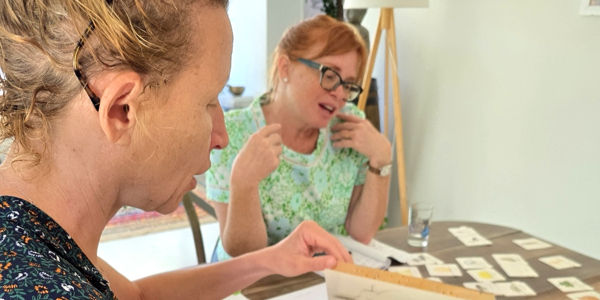
Lessons generally take place for three hours each morning, from Monday to Friday. This is a deliberate choice. Three hours provide enough time for meaningful learning without turning your entire stay into a classroom marathon.
During our lessons, we can focus on listening comprehension, speaking, vocabulary, pronunciation or grammar, depending on your needs. Most importantly, what we study can be directly connected to what you are going to experience.
If we are visiting a market, certain words and expressions will naturally come in handy. If we are heading to Cassis or the Calanques, we might explore vocabulary related to landscapes and the sea. If you would like to feel more comfortable ordering in restaurants, we can practise those situations together.
The lessons prepare you for real life, and real-life experiences then reinforce what you have learnt. This continuity is what makes immersion so meaningful.
Meals: much more than a break in the day

In France, mealtimes are social occasions. We do not sit down simply to eat. We talk, tell stories, exchange ideas, discuss what we are eating and sometimes discover a new ingredient or local speciality.
During a French immersion stay, these moments are particularly valuable because conversation becomes spontaneous. The notebooks are closed. There are no exercises. And yet, you are still practising French.
We talk about the morning, food, cultural differences, Provence, travel or everyday life. Very often, it is during these moments that expressions studied in class begin to come naturally, without you even realising it.
Lunch is therefore an important part of the language immersion experience. With the usual Virginie in Provence programme, breakfast and lunch are included on the days spent at the house. Meal arrangements may be different on excursion days.
Excursions: when Provence becomes an open-air classroom

Excursions are not a break from learning. They are part of the learning experience.
During a typical week, two excursions are usually included. Depending on the season, your interests and the programme we create together, we might visit Aix-en-Provence, Cassis and the Calanques, Lourmarin, Saint-Rémy-de-Provence, Les Baux-de-Provence or other beautiful places in the region.
But the goal is not simply to tick famous landmarks off a sightseeing list. An excursion creates new opportunities to use French: reading a sign, understanding an explanation, ordering in a restaurant, asking a question, chatting with a shopkeeper, discovering a local tradition or learning vocabulary related to a landscape.
Even a simple walk can become an incredibly rich language-learning experience.
Most importantly, these conversations are real. They have not been created for a classroom exercise. You need some information, so you ask a question, and someone answers. You understand everything, some of it or perhaps almost nothing at all.
And that is perfectly fine. You try again.
That is exactly how confidence grows.
How much progress can you really make during a French immersion stay?

Let me be very clear: one week of immersion will not make you bilingual. And I would never promise you that.
However, a single week can profoundly change the way you use the French you already know. This is often where the most remarkable progress happens.
Some people know a great deal of vocabulary but are afraid to use it. Others understand French reasonably well but panic when they have to respond. Others mentally construct every sentence before saying it aloud.
As the days go by, these habits gradually begin to change. You respond more spontaneously. You accept that you will not understand everything. You ask people to repeat themselves. You rephrase your sentences. You find another way to express yourself when you cannot remember a particular word.
In other words, you begin to communicate.
Progress can also be very tangible: understanding more conversations, expanding your vocabulary, improving your pronunciation, using grammatical structures more naturally or finding it easier to understand French people when they speak at their normal pace.
But the most important change is often the same: confidence.
Because once you dare to speak, you create even more opportunities to learn.
What participants remember most about their immersion

The most memorable moments of a French immersion experience are not always the ones you might expect.
Of course, there are the landscapes, villages, markets, meals and excursions. But when participants look back on their stay, it is often the little moments they remember most.
A conversation they never thought they would be able to have. A joke they understood. An unexpected encounter. A word they finally managed to pronounce. A meal during which they suddenly realised they had been speaking French for quite some time without even thinking about it.
These small victories may seem insignificant, but they are often the ones that stay with us.
Between the beginning and the end of the stay, something has changed. You hesitate less, speak more freely and French gradually begins to feel more natural.
That is why I prefer to talk about progress rather than performance. There is no exam to pass at the end of your stay. There is simply one question: do you feel more comfortable speaking French than when you arrived?
Mistakes to avoid when choosing a French immersion programme

There are many French immersion programmes available today. Before choosing one, it is important to look beyond the photographs and the number of lesson hours advertised.
Choosing a programme based on price alone
Two programmes with different prices do not necessarily offer the same experience. Look carefully at what is actually included: the number of lesson hours, group size, accommodation, meals and excursions.
Most importantly, ask yourself how much time you will genuinely have to speak French.
Assuming more lesson hours automatically mean more progress
Eight hours of lessons do not necessarily mean eight hours of effective learning.
Immersion needs to leave room for actually using the language. It is often during a conversation at the market, a meal or an excursion that something studied in the morning begins to feel natural.
Overlooking group size
If your main goal is to speak more French, consider how much speaking time you will actually get.
In a group of ten people, the teacher inevitably has to divide their attention between students. With one-to-one lessons, every conversation is focused on you.
Forgetting the importance of your relationship with your host
This is something people can easily overlook. Yet you will spend a considerable amount of time with the person welcoming you. You will make mistakes in front of them, ask questions, share meals and explore their region together. It is therefore essential that you feel comfortable with their teaching style and the way they support you.
Trying to turn your immersion into a sightseeing marathon
Provence has an incredible amount to offer, but trying to see everything can be counterproductive.
An immersion stay is not a race. Taking the time to enjoy a coffee, have a conversation or explore a market can sometimes be far more rewarding than squeezing a third sightseeing stop into the day.
What makes Virginie in Provence different?

Virginie in Provence was not created to recreate a traditional language school in a private home. The idea is different. I want you to be able to learn French while truly experiencing life in Provence.
It starts with a highly personalised approach. Before you arrive, I take the time to understand your level, your expectations and what motivates you. During lessons, I adapt to your needs. Over meals, our conversations continue naturally. And during excursions, I introduce you to the region where I live and which I love sharing with others.
This personal connection matters to me. I do not simply want to take you to the most famous attractions. I also love introducing you to the little things that make up everyday life here: a market, a local speciality, a French custom, an expression, an unexpected encounter or an unplanned conversation.
These are often the moments that create the most wonderful memories.
Keeping my immersion programmes intentionally small also helps preserve this personal connection. You are not simply another student joining an anonymous group. You are welcomed as an individual, with your own story, your own level of French and your own interests.
My role is to guide you, open the doors to the Provence I know and love, and create an environment where you feel confident enough to speak French.
But the experience is ultimately yours. Your encounters, discoveries and small victories are what make your immersion unique.
That is probably the best way to describe Virginie in Provence.
I do not simply want to teach you French. I want to give you the confidence to live it.
Learning French in Provence: what if the next story were yours?
Learning a language takes time. There is no magical shortcut. But there are moments that change the way we learn.
The first time you understand a conversation without translating. Your first spontaneous exchange. The first meal during which you realise you have been speaking French for several minutes without searching for your words. The first moment when you simply forget that you are “practising your French”.
These are the moments I hope to create during an immersion stay.
Not a perfect week. Not a week during which you never make a mistake. Quite the opposite.
I want you to feel comfortable making mistakes, asking questions, searching for words, trying again, discovering Provence and meeting the people who live here.
And at the end of your stay, when someone speaks to you in French, I hope your first thought will no longer be: “I hope I can find the right words to answer.”
Instead, it will simply be: “What would I like to say?”
Because perhaps that is the exact moment when French stops being a language you are learning.
And becomes a language you are living.
Frequently asked questions about French immersion in Provence
Do I need to speak French already to join an immersion programme?
As the programme is personalised, your French level is assessed before your stay. The goals and lesson content are then adapted to your level.
How many hours of French lessons are there each day?
The usual programme includes approximately three hours of lessons per day, from Monday to Friday. However, your French immersion continues naturally during meals, excursions and everyday conversations.
How long does a French immersion stay at Virginie in Provence last?
The standard programme includes six nights, usually from Sunday to Saturday, with five mornings of French lessons.
Can I come with my partner or another person?
Yes. You can come on your own, as a couple or with a companion who does not necessarily take part in the lessons. The arrangements depend on the package you choose.
Are meals included?
With the standard programme, breakfast and lunch are included on the days spent at the house, excluding arrival and departure days. Meal arrangements are different on excursion days.
How many excursions are included?
The standard programme includes two excursions per week. The destinations depend on the season, your interests and the programme we create together.
Where can we go on excursions?
Depending on your interests and the season, excursions may include Aix-en-Provence, Cassis and the Calanques, Sainte-Victoire mountain, Lourmarin, Saint-Rémy-de-Provence, Les Baux-de-Provence and other beautiful places in Provence.
Will I become bilingual after one week?
No, and that is not what immersion promises. However, a few days of intensive, real-life practice can help you build confidence, use your existing knowledge more spontaneously and identify exactly what you need to continue working on.
What is the best time of year to learn French in Provence?
There is no single best season. Provence changes considerably throughout the year. Spring, summer, autumn and winter each offer different experiences.
The best time to visit depends mainly on what you would like to discover and how you enjoy travelling.
Would you like to experience your own French immersion in Provence?
If you would like to learn French differently, take your time speaking, discover Provence from a local perspective and enjoy an experience designed around your level and interests, I would be delighted to hear from you.
We can talk about your French, what you would like to improve and, most importantly, what you would love to experience during your stay.
Get in touch and let's create your own French immersion experience in Provence.


Comments