


Candlemas in Provence: tradition, crêpes and vocabulary
- virginieinprovence
- Dec 4, 2025
- 4 min read
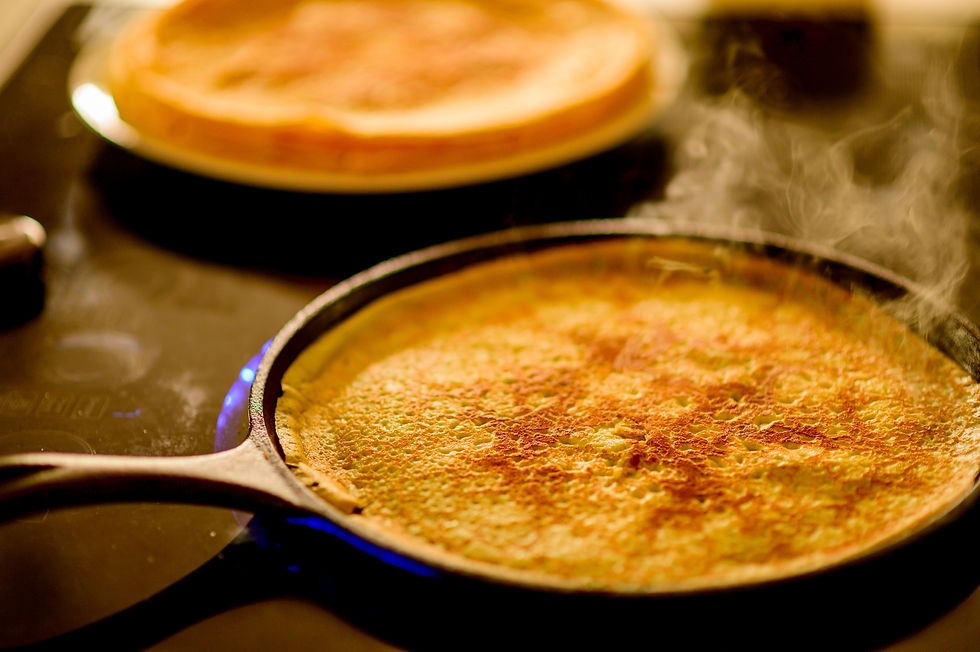
Like many families in Provence and across France, we celebrate La Chandeleur. It is an excellent (and official) excuse to eat crêpes.
Where does La Chandeleur come from?
On Monday, February 2nd, it will be time to make crêpes. Young and old alike know La Chandeleur, also known as Candlemas. But do you really know its origins?
Two stories about its origin
There are two main stories explaining the origin of La Chandeleur.
A religious origin (and a celebration of light)
Originally a pagan festival, La Chandeleur was later adopted by Pope Gelasius I. It celebrates light: daylight, candles, and divine light. The round shape of crêpes and their golden color symbolize the sun.
An ancient origin (unrelated to crêpes)
Another story dates back to Roman antiquity. It refers to a ceremony celebrating a new period of the year and the first sowings. Nothing to do with crêpes… but the idea of a “new beginning” is still there.
The tradition of the coin in the pan
While writing this article, I discovered that there is also a tradition linked to La Chandeleur. Here it is: you hold a coin in your hand (often referring to a gold coin) and flip the crêpe by tossing it in the air. If the crêpe lands perfectly, it is said to be a sign of financial prosperity for the year. I must admit that I didn’t know about this tradition before writing this article, and we have never tried flipping a crêpe while holding a coin at home. What about you—have you ever tried?
Crêpe or galette: what’s the difference?
My grandfather was Breton, and Breton traditions have always been important in my mother’s family, especially for my mother. As children, my brother and I spent many summers there. The region is beautiful, although as someone who later settled in the south of France, I always found the climate difficult to adapt to. In any case, part of my roots are there, and that may be why, while pregnant with my eldest son, I went to Brittany to train as a crêpe maker. That’s where I reviewed all the basics, especially the difference between a crêpe and a galette.
So let’s start at the beginning.
A crêpe is sweet

It is made with wheat flour and is usually eaten as a dessert or a snack.
The toppings can be very varied: sugar, chocolate, jam, salted butter caramel… and for the most indulgent, ice cream and whipped cream.
A galette is savory

Savory galettes, another way to enjoy crêpes as a full meal.A savory crêpe, the galette is made with buckwheat flour.
The batter is darker and more technical to prepare.
Just like crêpes, the toppings vary widely: ham, cheese, egg, mushrooms, and more.
Family preferences
Recipes are endless, but traditions run deep in my mother’s generation. My mom always (and I really mean always) eats a sugar crêpe. When it comes to galettes, she always orders a ham and cheese galette—and I don’t think she will ever change. My generation, and that of our children, is more flexible.
Cider: sweet or dry?

With cider, just like wine, it depends on the dish.
Sweet cider is generally drunk with sweet crêpes.Dry cider is usually enjoyed with galettes.
A bolée is similar to a wine glass, but for cider. It looks like a small bowl with a handle. It is therefore possible to order one bolée for the main dish and another for dessert, especially since cider is not a very strong alcohol.
Sweet cider ferments for a shorter time. It is lighter, sweeter, and less alcoholic. Dry cider is the most commonly consumed in France, and it is not unusual to drink dry cider throughout the entire meal. alcoolisé. Le brut est le plus consommé en France. Il n’est pas rare de boire du cidre brut tout le long du repas.
My sweet crêpe recipe (a family recipe)

Now that I have shared a bit of the history of La Chandeleur and my own story, I would like to share the recipe that was passed down to me.
Let’s start with the ingredients.
Ingredients for the batter
To make the batter, you will need one egg, 12.5 cl of milk, four tablespoons of flour, and three tablespoons of sugar.
Preparation steps
Start by mixing the sugar, egg, and flour in a bowl. Gradually add the milk while whisking vigorously until you obtain a smooth and even batter.
Heat a frying pan over medium heat. Once hot, pour in a ladle of batter and let it cook until the edges begin to lift and detach. Flip the crêpe and cook the other side for a few moments.
Add the topping of your choice, fold the crêpe into a triangle, and enjoy—with or without cider, as you wish.
Simple and effective!
I hope you will have the opportunity to try this recipe at home, in Brittany… or during an immersion stay with us.
Vocabulary
To finish, here is some vocabulary related to La Chandeleur, crêpes, and galettes.
Français | Anglais |
Une crêpe | A pancake |
Une galette / une crêpe salée | A savory pancake |
De la farine de blé | Wheat flour |
De la farine de sarrasin | Buckwheat flour |
Du cidre | Cider |
Du cidre doux | Sweet cider |
Une bolée | A cider bowl |
Du cidre brut | Dry / hard cider |
Une poêle | A frying pan |
Un œuf | An egg |
Du lait | Milk |
Une garniture | A topping |
Une louche | A ladle |
Une pâte à crêpe | Batter |
Retourner | To flip |
If you come to stay with me for a French immersion experience in Provence, I will help you discover the landscapes, culture, and gastronomy—while also helping you improve your French.
See you soon in Provence!
Virginie in Provence


Comments