


Visit the Renoir Museum and a French school with Kathleen and Georges during their stay in Provence
Updated: Sep 21
Hello, my name is Kathleen.
In November 2019, I came to Provence with my husband Georges for a French immersion stay with Virginie.
It was a dream for me: staying in France, practising French every day and discovering Provence in a different way. One of the places I absolutely wanted to visit during our stay was the Renoir Museum in Cagnes-sur-Mer.
I mentioned it to Virginie, and she organised the excursion for us.
It was raining that day, but that didn’t stop us from enjoying the visit. And the day had another very different experience in store for us: after the museum, we were expected at Virginie’s children’s school to talk about the United States to a kindergarten class.
A day of French painting, conversations in French and meeting children that became one of my favourite memories of our stay.
Visit the Renoir Museum in Cagnes-sur-Mer
We travelled to Cagnes-sur-Mer with Virginie to discover the Renoir Museum, located at the Domaine des Collettes.
In November, the opening hours were quite limited when we visited, and I would have loved to have even more time there because there was so much to discover.
Pierre-Auguste Renoir was born in Limoges in 1841 and died at the Domaine des Collettes in Cagnes-sur-Mer in 1919.
He is, of course, famous for his paintings, but he also created sculptures with Richard Guino. Renoir was married to Aline Charigot, and they had three sons: Pierre, who became an actor, Jean, a film director and screenwriter, and Claude, a ceramic artist.
Renoir moved to Cagnes-sur-Mer during the final years of his life. He suffered from severe arthritis and hoped that the milder climate in the south of France would help him.
He lived at the Domaine des Collettes for the last twelve years of his life.
Step inside the house where Renoir lived

The estate is surrounded by olive and citrus trees. Here, you can discover Renoir’s family home, garden and studio. The house has three floors.
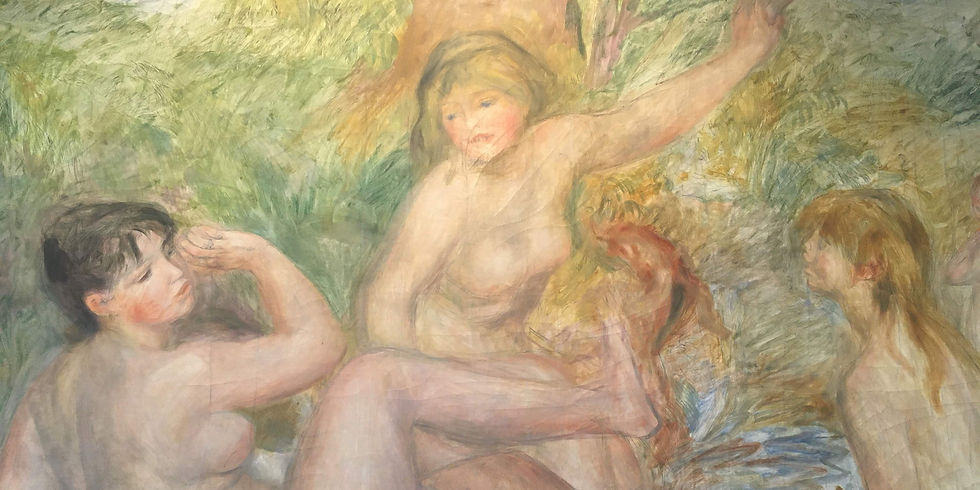
On the ground floor, we discovered sculptures created by Renoir with Richard Guino. Guino’s contribution to these works was recognised much later. I found it interesting to see that the women represented in the sculptures looked very similar to those Renoir painted.
Upstairs, we discovered the family’s furniture, paintings and various objects connected with the painter’s life.
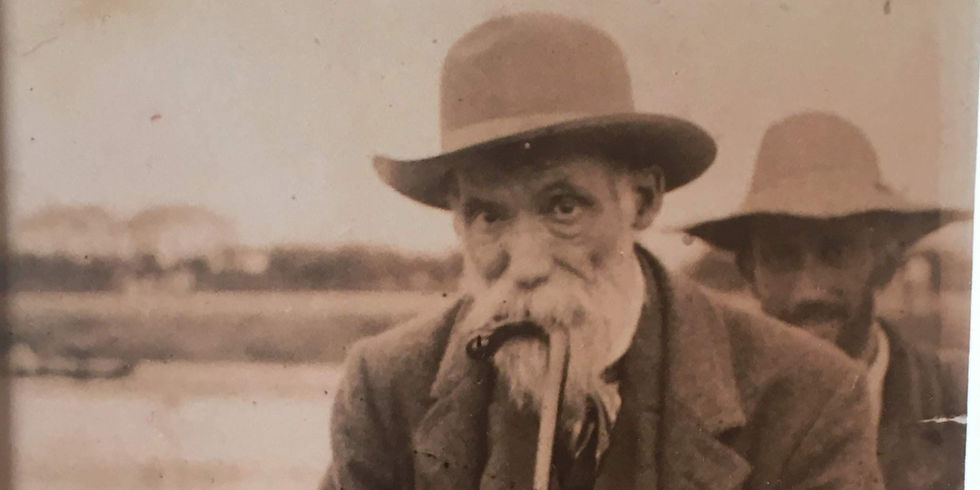
But what interested me most were the photographs of Renoir and his family.
Looking at photographs taken over the years, I noticed something that made me smile: his family grew older, his children grew up… but Renoir always seemed old to me!
I was also very surprised by the size of some of the rooms in the house, especially the bathroom and the kitchen.
In the end, it was these small details of everyday life that helped me imagine Renoir and his family living in this house.
Discover Renoir’s studio

One of my favourite places to discover was the painter’s studio.
His wheelchair, easel and palette were still there.
Renoir suffered from severe arthritis and used a wheelchair. Seeing his wheelchair right next to his painting materials made this part of his story feel much more real. There is also a studio in the garden, reconstructed exactly as it was in 2019 to mark the centenary of Renoir’s death.
The artist had created a space with large windows that allowed him to stay warm inside while watching the models posing outdoors. The garden itself is also worth taking the time to explore. Despite the rain that day, we were able to appreciate the large trees, olive trees and surroundings where Renoir had chosen to live and work.
Discover Renoir through the people who knew him
During the visit, we also watched two videos.
In one of them, a woman who had been one of Renoir’s favourite models shared her memories many years later.
Another video presented Renoir and the estate through the eyes of his son Jean.
I really enjoyed these accounts because they added another dimension to what we were discovering inside the house.
They allowed us to see Renoir as more than just a famous painter. Behind the paintings was also a man, a family, a home and an everyday life in Cagnes-sur-Mer.
Practise French during an excursion

It was raining heavily that day.
Georges drove, which gave me the opportunity to chat with Virginie in the car. We were very grateful to him! And that was part of my immersion too.
During the stay, French wasn’t limited to our lesson time. We could continue speaking during car journeys, excursions and visits.
The museum itself also offered plenty of vocabulary connected with art and everyday life.
A few useful French words at the museum:
un peintre: a painter, someone who creates paintings
une toile: a canvas, the surface an artist paints on
un chevalet: an easel, the stand used to hold a canvas
une palette: a palette, the surface on which a painter places and mixes colours
un atelier: a studio, the place where an artist works
un modèle: a model, someone who poses for an artist
une sculpture: a sculpture, a work of art created by shaping a material
This is one of the things I enjoyed about my stay with Virginie: learning vocabulary while having a real experience.
After Renoir, off to a French school!

After our visit to the museum, our day was far from over.
We went to the kindergarten that Tom and Lily, Virginie’s children, attended at the time.
Tom was very proud to see us arrive in his classroom.
Georges and I had prepared a short presentation about the United States for the children, who were around five years old.
And I have to admit, we were quite nervous!
We had planned to talk about several things: how to travel to the United States, the animals you can find in our country and particularly in Florida, as well as some of the differences between sports played in France and in the United States.
In the end, everything went very well.
Talking about the United States with French children

The children were adorable.
They participated, asked questions and laughed with us.
Our presentation didn’t last very long — you have to be efficient with five-year-olds! — but it was a short, intense and very joyful experience.
This encounter also gave us the opportunity to discover a small part of everyday life in France that we probably would never have experienced as ordinary tourists.
We were no longer simply visiting Provence.
For a little while, we were in a real French classroom, talking with children and telling them about our own country. And it remains one of my favourite memories of our immersion.
Learn French by experiencing Provence

When I chose a French immersion stay with Virginie, my goal was, of course, to improve my French.
But this day is also a perfect example of what else I discovered during our stay.
In the morning, we were in Renoir’s home learning about the story of a great French painter. A few hours later, we were in a kindergarten with a class of French children.
In between, we had spoken French in the car, chatted with Virginie and continued discovering everyday life in France. That is the combination I loved. Lessons are important, but you also learn a language by using it in real life.
Virginie’s tip
If there is somewhere you would really like to visit during your immersion, mention it before your stay.
A museum, a village, a market or a place connected with French history and culture can become another opportunity to practise French.
And if you would like to visit the Renoir Museum, remember to check the opening hours before your excursion, particularly outside the main tourist season.
Frequently asked questions about the Renoir Museum in Cagnes-sur-Mer
Where is the Renoir Museum?
The Renoir Museum is located at the Domaine des Collettes in Cagnes-sur-Mer, on the French Riviera. Renoir lived on this estate during the final years of his life.
What can you see at the Renoir Museum?
You can discover Renoir’s house, paintings, sculptures, furniture, photographs and various objects connected with his life. The estate also includes the painter’s garden and studio.
Why did Renoir move to Cagnes-sur-Mer?
Renoir suffered from severe arthritis. He moved to the south of France partly in the hope of benefiting from the milder climate. He lived at the Domaine des Collettes for the final twelve years of his life.
Can you visit a museum during a French immersion stay with Virginie?
Excursions and visits are opportunities to discover Provence while continuing to use French in real-life situations. Whenever possible, the programme can also take into account the interests and wishes you share before your stay.
A day I still remember
I wanted to visit the Renoir Museum, and Virginie made that visit possible.
But when I think back on that day, I don’t only remember the paintings, the studio or the house.
I remember the rain. Georges driving while I was able to talk with Virginie. The photographs of Renoir’s family that made me smile. The wheelchair and easel in the studio.
And then I remember arriving at the school, how nervous we were before the presentation, how proud Tom was and the children laughing with us.
That is what I remember most about my French immersion in Provence.
I came to learn a language.
And I left with memories of life in France.
Would you also like to experience French every day while discovering Provence?
Discover French immersion stays with Virginie in Provence, combining private lessons, conversations, everyday life and exploring the region.


Comments