


Why I love the Calanque de Sormiou so much

There are places you discover for the first time and immediately know you will want to return to. For me, the Calanque de Sormiou is one of those places.
And yet, even though I live in Provence and know the region quite well, I had never been there before. It all began during our holidays, when we met Sidonie, Nicolas and their daughter Charlotte, a family from Marseille whom we immediately got along with.
We wanted to see each other again once we were back home and, of course, when people from Marseille offer to show you a place they love close to home, you follow them!
That is how, a little while later, we found ourselves in Sormiou.
And what a discovery!
Discovering Sormiou for the first time
The Calanque de Sormiou is located in Calanques National Park, south of Marseille.
To get there, you gradually leave the city behind and enter an increasingly rocky landscape. Then, around a bend in the road, the calanque appears: white cliffs, Mediterranean vegetation, pine trees, cabanons and, in the middle of it all, incredibly blue water.
Sormiou is one of the few calanques with a sizeable beach, made up of sand and pebbles. On the other side, there is also a small harbour.
But what struck me when we arrived was that Sormiou is not simply a beautiful landscape.
You can feel that there is real life here.
And that has a lot to do with its famous cabanons.
The cabanons of Sormiou and the story of Marie de Sormiou
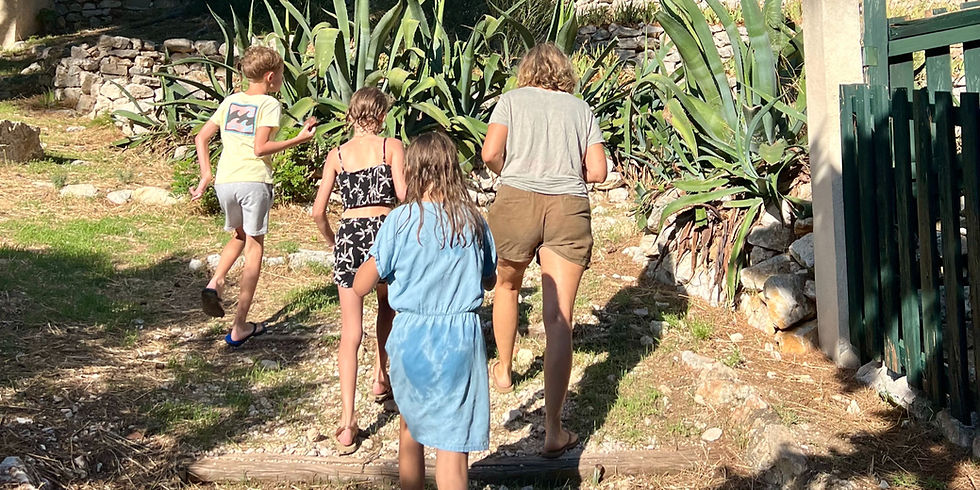
When you arrive in the calanque, these little houses are completely part of the scenery. Some have been here for so long that it is difficult to imagine Sormiou without them.
Their history is closely linked to Marie de Sormiou.
In 1876, Charles Buret and Augustine Pascalis bought the calanque at auction and gave it to their daughter Marie as part of her dowry. In 1885, she married Count Alfred de Ferry. A writer and poet, she used the name Marie de Sormiou for her literary work.
Deeply attached to the Calanques, she would come to Sormiou on horseback to picnic and write. She was acquainted with figures including Frédéric Mistral and Anna de Noailles.
In 1894, she and her husband decided to build a summer residence in the calanque. Compared with the small buildings around it, the house seemed so imposing that it quickly became known as “the Château”. The building still exists today and is home to the restaurant Le Château de Sormiou.
The couple also had 17 cabanons built and rented them out at very affordable rates. Originally, the cabanons were used in particular by fishermen as shelters and places to store their nets. Over time, they became places where Marseille families would spend their days and holidays.
Little by little, a true cabanon culture developed: people came here to spend time together, share meals, swim, play pétanque and enjoy the sea.
When you walk around Sormiou today, you quickly understand what that means.
The cabanons are not simply pretty to look at. They tell part of the story of the Calanques.
First thing to do: go for a swim!
Once we arrived, we didn’t resist the call of the water for very long.
Our first swim of the day!
The children also tried paddleboarding while the adults enjoyed the sea.
It was exactly the kind of day I love: nothing too complicated, no schedule to follow, just enjoying the place and being together.
And in Sormiou, with this clear water surrounded by cliffs, that’s quite easy.
Lunch with friends

After our swim, it was time for lunch.
This is another memory I really wanted to keep from that day because, in the end, it says a lot about what I love about Provence.
We gathered around the table for veal chop, lamb chop and grilled vegetables.
Alexandre had brought a bottle of Château Vignelaure for his 40th birthday. Nicolas had brought champagne and, of course, there was also some nicely chilled rosé.
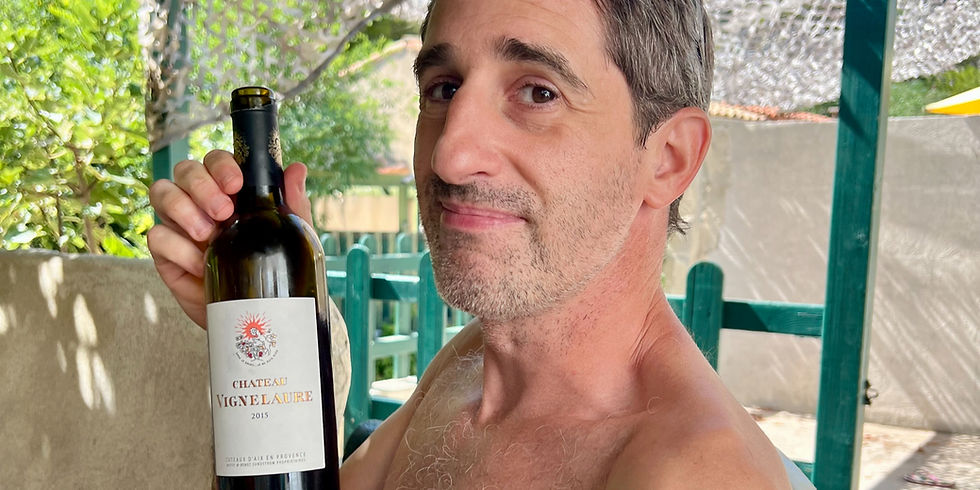
It may not be the most spectacular panorama of the day, but these are exactly the kinds of moments I like to photograph and remember.
Because, for me, Provence is not simply a succession of beautiful villages and landscapes.
It is also this: a big table, something good to eat, a bottle opened for a special occasion, conversations that go on and on, and nobody really looking at the time.
And that is exactly what I love helping people discover during my French immersion stays.
Language is learned around a table too: when you ask someone to pass the bread, talk about what you are eating, tell a story, or when the conversation heads in a direction nobody had expected.
A second swim… because one was not enough
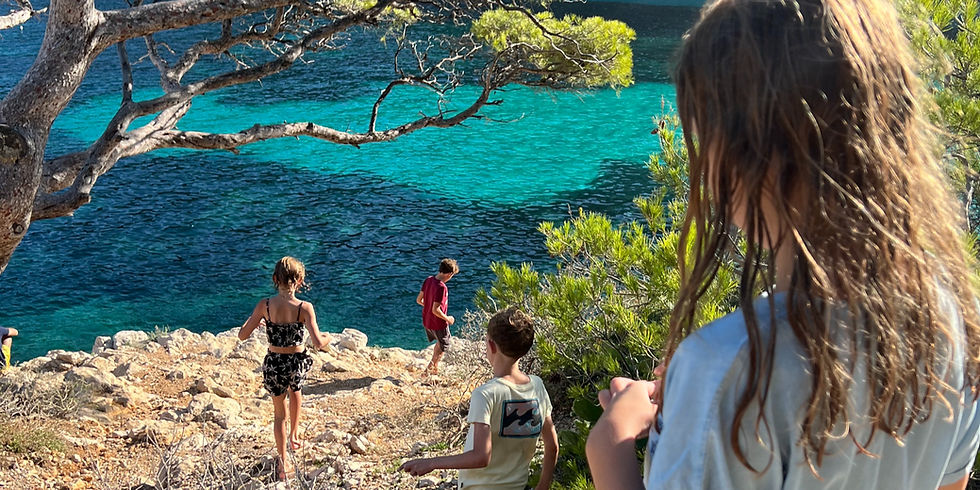
After lunch, we went swimming again.
Because in Sormiou, honestly, it’s difficult not to.
Then we wanted to explore a little more of the calanque.
We set off on foot towards the small harbour, passing between the cabanons.
It is another side of Sormiou that I really loved.
You move away from the main beach, walk among the little houses and gradually discover the harbour, the boats and a completely different atmosphere.
As we continued, we also found another, much more secluded little beach.
These small detours are often what I enjoy most. You simply walk for a few minutes and discover something you had not planned.
Seeing Sormiou from above
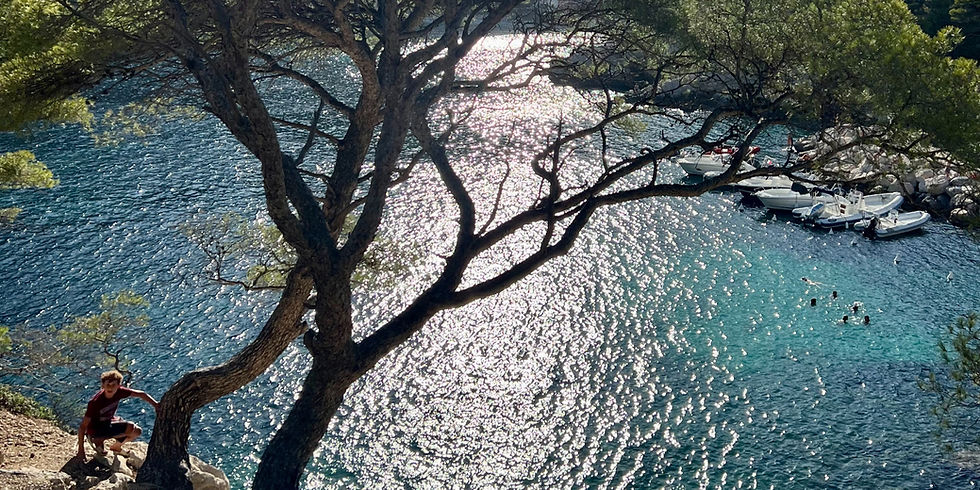
We then followed a path that took us a little higher above the calanque.
And there, of course, the reward is the view.
From above, you understand the shape of Sormiou much better: the limestone cliffs surrounding it, the cabanons gathered around the beach and small harbour, and that long stretch of blue opening onto the Mediterranean.
I think this is one of the things I love most about the Calanques: after just a few minutes of walking, the landscape changes completely.
Down below, you experience the calanque.
From above, you contemplate it.
Virginie’s tip
If you go to Sormiou, take your time.
Don’t come simply to see the calanque, take three photos and leave.
Go for a swim. Walk to the small harbour. Move a little away from the beach. Head up onto the trails if conditions allow. Stop and take in the view. And if you can avoid walking during the hottest part of the day, do. In Provence, the sun can be very intense and some sections of the trails offer very little shade.
Remember to take enough water and wear good walking shoes.
Finally, always check access conditions before you leave. Road access to Sormiou is regulated at certain times of year, and access to the massif may also be restricted depending on the wildfire risk.
Can you drive down to Sormiou?
This is an important question because access to Sormiou is not the same throughout the year.
The road down to the calanque is regulated during certain periods, particularly in the warmer months. Access can also change depending on the wildfire risk. On our first visit, we were able to drive directly down thanks to our friends from Marseille, who have a pass.
But if you are planning your own day in Sormiou, don’t rely on information you found several months earlier. Check the access conditions on the day of your visit with the City of Marseille or Calanques National Park.
During busy periods, Calanques National Park also recommends walking and using public transport to reach the trailheads.
What if we learned French like this?
That day also gave me lots of ideas for my immersion stays.
Just imagine learning words such as une calanque, un cabanon, une falaise, un sentier, une crique, se baigner or prendre de la hauteur while you are actually seeing or experiencing them.
Everything becomes easier to remember. More importantly, you speak French without feeling as though you are doing an exercise.
We chat in the car. We describe what we see. We talk over lunch. We search for a word. We ask a question. We walk. We interact with the people we meet.
That is exactly how I see language immersion.
There are the French lessons. And then there is everything that happens around them.
That is often when the language truly comes alive.
A few French words to know before going to Sormiou
Une calanque: a narrow coastal inlet surrounded by rocky cliffs, typical of the coastline between Marseille and Cassis.
Un cabanon: a small, simple building. Cabanons are part of the history and identity of the Calanques.
Une crique: a small natural cove.
Un sentier: a small path, usually walked on foot.
Se baigner: to go into the water to swim or simply cool off.
Prendre son temps: to take your time, not to rush. And in Sormiou, it is probably the most important expression to know!
FAQ – Visiting the Calanque de Sormiou
Where is the Calanque de Sormiou?
Sormiou is south of Marseille and is part of Calanques National Park. It is one of Marseille’s major calanques.
Can you swim in Sormiou?
Yes. Sormiou beach is suitable for swimming in the calanque. In summer, it can get very busy. Of course, you should always take weather conditions and any safety instructions into account.
Can you drive down to Sormiou?
It depends on the time of year. Traffic on the Sormiou road is regulated on certain dates and access may also be prohibited depending on the wildfire risk. Always check official information before your visit.
Can you walk to Sormiou?
Yes. You can reach the calanque on foot, but remember that you will have to walk back up, and take the elevation gain and, especially, the summer heat into account. Bring water and suitable footwear.
Is Sormiou worth visiting?
I’m probably not the most objective person to answer that question!
I love Sormiou. Not only because the calanque is beautiful, but because you can genuinely spend an entire day there: swimming, walking, having lunch, discovering the cabanons, heading to the small harbour and simply enjoying the Mediterranean.
Why I keep going back to Sormiou
When I think of Sormiou, I don’t really think only of a calanque.
I think of that first day with Sidonie, Nicolas and Charlotte.
Of the children on the paddleboard.
Of lunch.
Of the second swim.
Of our walk towards the small harbour.
And of that view when we climbed a little higher.
That is exactly why I love Provence so much.
Of course, there are extraordinary landscapes. But what truly stays with us is often the moments we experience within those landscapes. And that is also what I want to share with the people who come to learn French with me.
Not simply to show them Provence. To experience it with them.
You may also like
Discover why living the language every day can help you learn French differently.
My ideas for discovering the region while naturally practising your French.
Another way to discover the Mediterranean, between the village, the sea and the Provençal art of living.


Comments